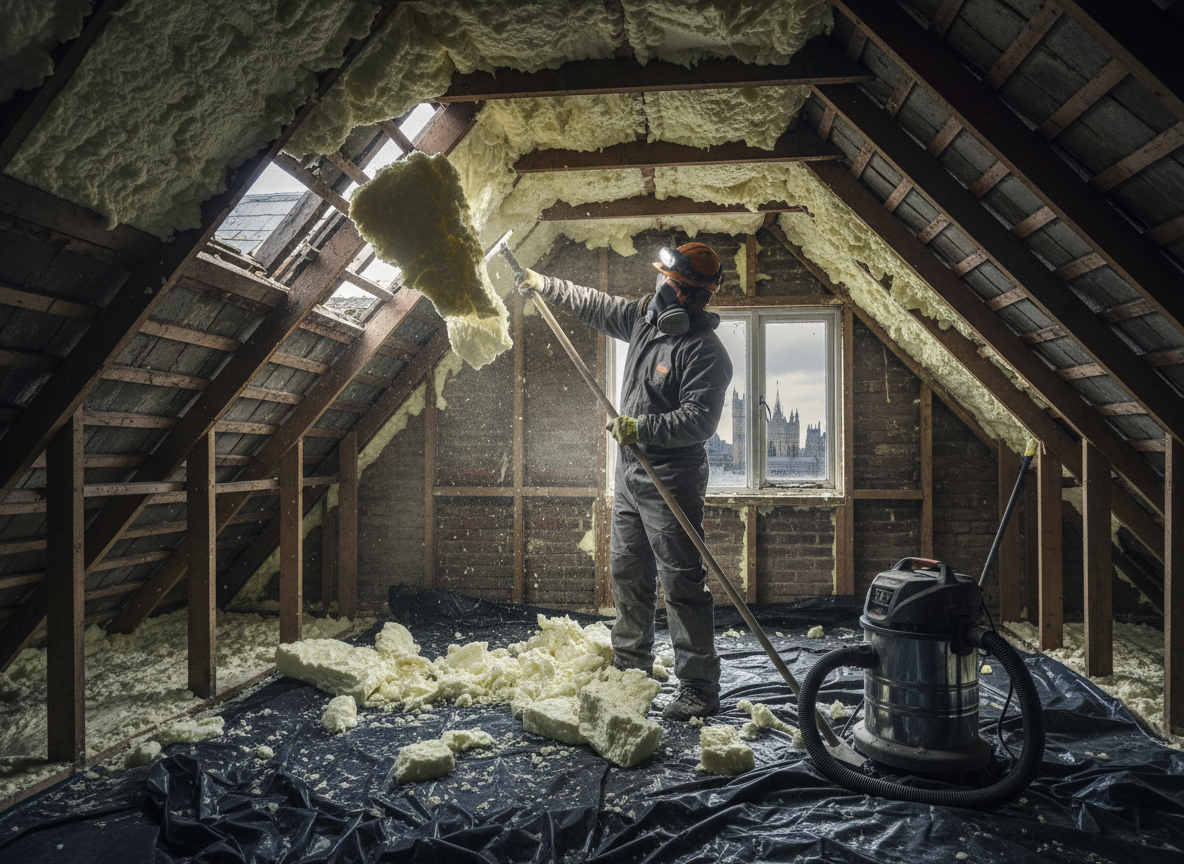
Open cell spray foam bonds tightly to joists and brickwork in London terraces and Edwardian semis, trapping moisture against timber that already faces high winter rainfall. Removal starts with careful sectioning to avoid disturbing asbestos or lead paint common in pre-1930 stock around Waltham Forest and Hackney. Technicians use negative air machines to contain dust while cutting the foam free in manageable blocks rather than shredding it, which spreads particles through party walls.
In properties near the River Lea or on clay soils in Epping Forest fringes, open cell foam often pulls water from below ground level, leading to hidden rot in floor joists once the insulation is gone. The work requires checking ventilation paths that Victorian builders left under suspended floors, then restoring airflow so new damp does not return. Disposal follows Environment Agency rules for construction waste generated in Greater London, with loads taken to licensed sites rather than skipped on the street.
Access routes in narrow South Woodford terraces frequently limit equipment size, so crews work with smaller vacuums and hand tools to reach lofts above kitchen extensions. Homeowners in these streets often discover the foam was sprayed over electrical cables during earlier retrofits, requiring isolation before cutting begins. Once cleared, the team inspects for remaining residue that could affect new insulation choices suited to London’s variable weather.
After removal, surfaces are left ready for inspection so owners can decide on breathable alternatives that suit the age and construction of their building. This step prevents repeat issues seen when foam is simply covered over in damp London basements and roof voids.
Technician insight
In London, the thing that catches most people out with open cell spray foam removal is how the foam has wicked moisture from the clay subsoil into floor joists under 1930s semis around George Lane and Woodford. Homeowners assume the foam is just sitting on top but once you cut into it you find the rot has already started along the wall plate. That changes the job from a straight extraction to a timber check before any new insulation goes back in.
South Woodford Terrace Loft
Open cell foam had been sprayed across the entire loft of a 1920s terrace, trapping condensation against the rafters. Inspection showed water staining along the wall plate where clay soil held moisture. The team isolated electrics, cut and vacuumed the foam in sections, then cleared residue so the owner could install a breathable membrane instead.
How it works
- 1
Site Assessment
Walk-through of loft, cavity walls and any extensions to map foam depth and hidden services.
- 2
Containment Setup
Negative pressure zones and floor protection installed to keep dust inside the work area.
- 3
Foam Extraction
Sectional cutting and vacuum removal of open cell material without damaging original timbers.
- 4
Clearance and Disposal
Final clean, waste bagged for licensed haulage, and ventilation paths checked.
Pricing
Cost varies with access difficulty, depth of foam and number of rooms affected in London properties.