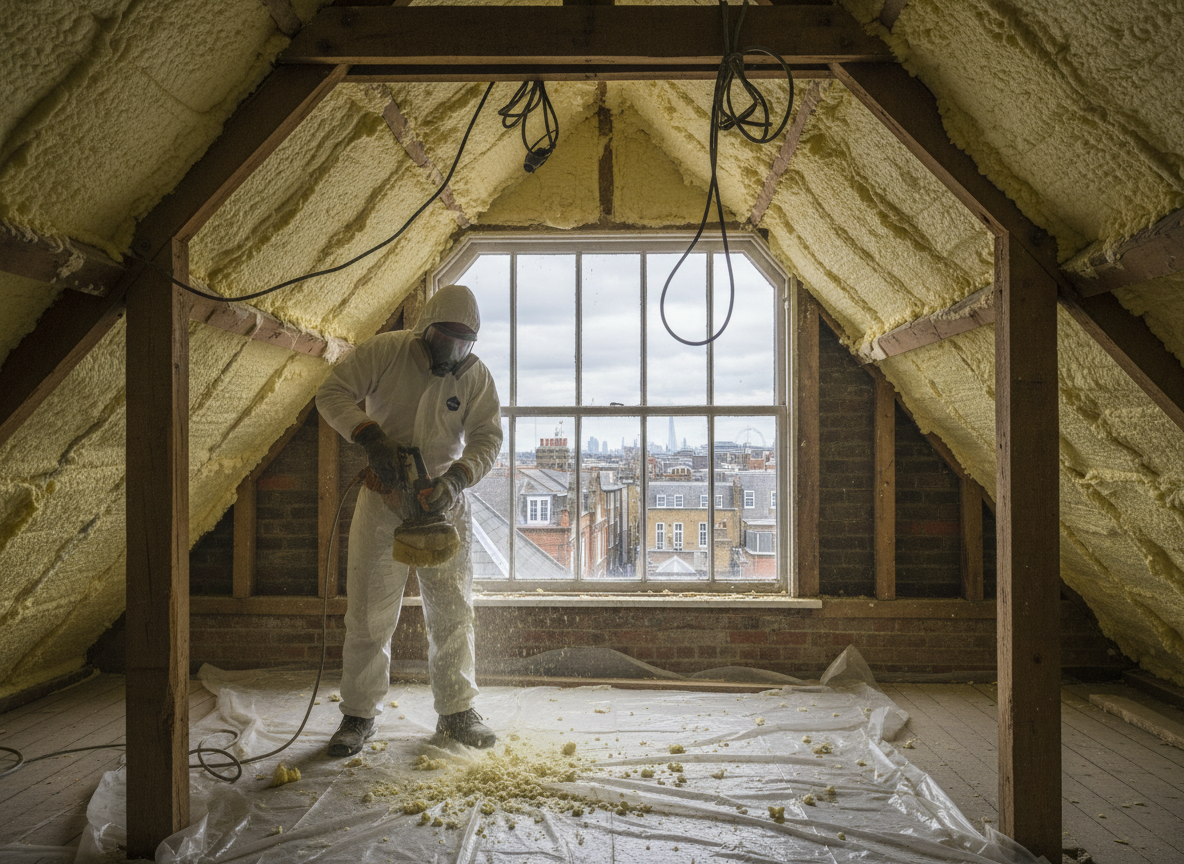
London commercial stock frequently includes 1960s-1980s concrete-frame warehouses and converted Victorian industrial buildings in areas such as Hackney, Southwark and the Royal Docks. Closed-cell spray foam installed decades ago now traps moisture against brick and concrete, accelerating corrosion of steel fixings and creating hidden damp patches that affect tenant fit-outs. Removal requires staged mechanical scraping followed by solvent softening of residue, with constant monitoring to avoid breaching vapour barriers or disturbing asbestos-containing materials common in pre-1980 ceilings.
Weather patterns in the capital add complexity: prolonged winter drizzle and high humidity slow drying times after foam extraction, while summer heat can cause rapid off-gassing of solvents. Crews working on flat roofs in Canary Wharf or multi-storey units in Stratford must therefore schedule extraction windows around forecast rain and maintain negative-pressure containment to prevent odour migration into occupied floors below. Substrate inspection after removal often reveals previously hidden thermal bridging at steel columns that must be addressed before new insulation is applied.
Regulatory requirements in Greater London demand full waste consignment notes for polyurethane foam and any contaminated substrate. Pureguard Solution coordinates with licensed carriers from the 139 George Lane base, ensuring loads are tracked from site to approved disposal facility. Edge cases include foam bonded directly to profiled metal decking in retail units, where over-aggressive removal risks perforating the deck and triggering costly roof repairs.
Access restrictions in central London mean much of the work occurs outside normal trading hours. 24/7 availability allows crews to begin at 10 pm in occupied offices near Liverpool Street and finish before 6 am, minimising disruption to daytime operations while still completing the full extraction and substrate cleaning sequence.
Technician insight
In London the thing that catches most people out with Commercial Spray Foam Removal is the hidden moisture trapped behind foam on north-facing brick walls in buildings from the 1970s. Once you strip the foam you often find the steel angles are already rusting because the original install never had a vapour barrier, and winter rain keeps feeding it.
Stratford warehouse conversion
Closed-cell foam on a 1980s metal-deck roof had started to delaminate, allowing water to pond above the insulation. Inspection showed corrosion along the purlins and failed fixings. We removed the foam in sections under negative pressure, treated the steel, and handed the deck back ready for new single-ply membrane without any perforations.
How it works
- 1
Site Survey and Containment Setup
Technicians inspect the commercial space, identify foam type and thickness, locate services and establish negative-pressure zones with sealed poly barriers.
- 2
Mechanical Removal and Residue Treatment
Foam is cut and scraped in controlled sections; solvent gel is applied to remaining film on concrete or metal to loosen adhesion without damaging the substrate.
- 3
Substrate Cleaning and Inspection
Surfaces are neutralised and dried; any corrosion or thermal bridging is documented and reported to the building manager before new works begin.
- 4
Waste Segregation and Off-Site Disposal
All foam and contaminated material is bagged, labelled and removed under consignment notes to licensed facilities serving the London area.
- 5
Final Verification and Handover
Air quality checks and photographic records confirm the space is clear; a written report is supplied for the client’s compliance file.
Pricing
Cost depends on building height, foam thickness, access restrictions and waste volume; site visit required for accurate scope.