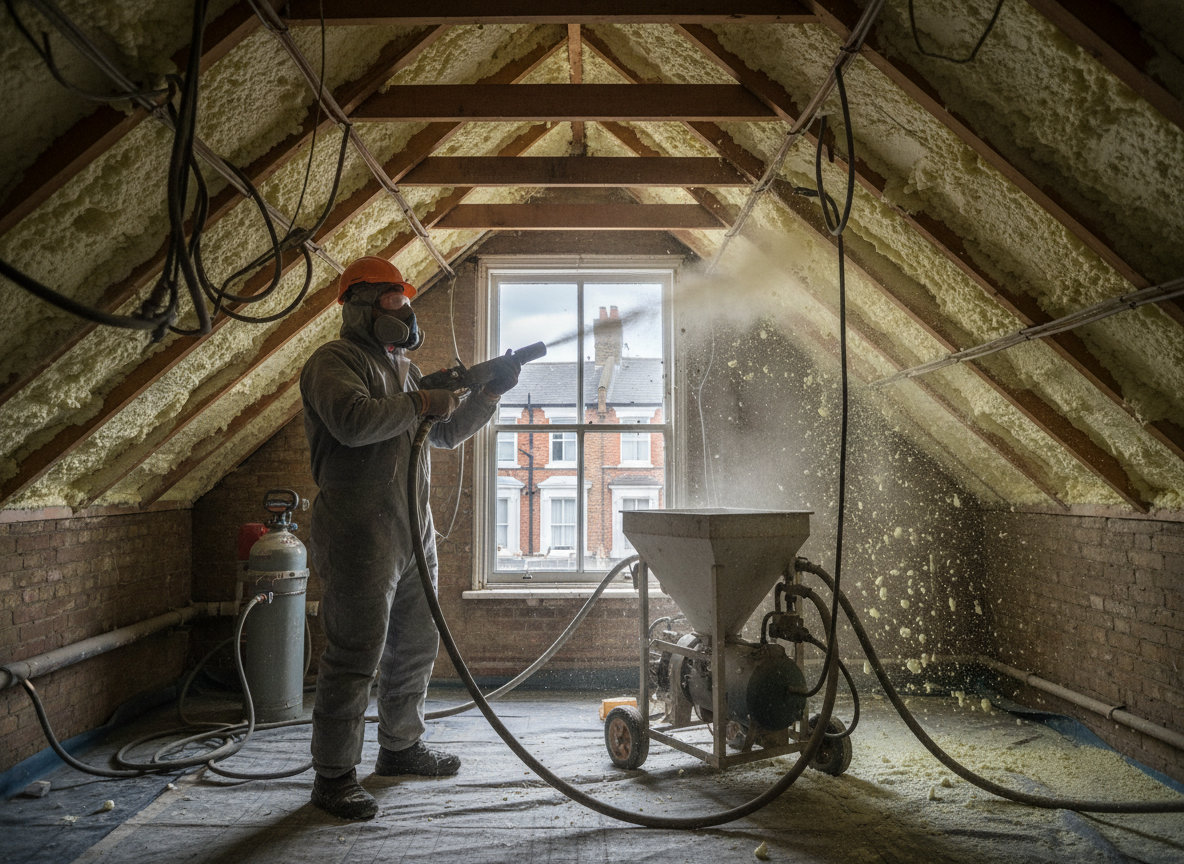
Sand blasting spray foam insulation removal demands careful control of media pressure and angle to strip polyurethane without tearing into underlying timber or masonry. In London many Victorian terraces and Edwardian semis contain original lath and plaster ceilings or early brickwork that can be easily compromised if the operator uses too coarse a grit or holds the nozzle too close. Moisture trapped behind failed foam in these solid-wall homes often leads to hidden rot that only becomes visible once the material is cleared, requiring on-site inspection before any blasting begins.
Greater London weather patterns add another layer. Frequent rain and high humidity mean crews must work in short windows or erect temporary enclosures to keep dust from migrating into neighbouring properties. Properties near the Thames or in low-lying postcodes such as those around E18 frequently show elevated ground moisture, which softens timber joists and changes how the blasting crew sequences the job to avoid vibration damage.
Regulatory considerations in London include listed-building consent for pre-1948 structures and party-wall agreements when work occurs on shared walls. Sand blasting produces fine silica dust that must be contained and extracted to meet local environmental health standards, especially in dense terraces where windows sit only metres apart.
Technician insight
In London the thing that catches most people out with sand blasting spray foam insulation removal is the age of the housing stock. Many E18 and surrounding terraces still have original lath and plaster or early brick that fractures if the blast pressure is even slightly too high, and the constant damp from London winters softens the timber so it gives way before the foam does.
Foam removal in a South Woodford terrace
Homeowner noticed persistent damp patches on bedroom ceilings. Inspection revealed closed-cell foam had trapped moisture against 1890s lath and plaster. We set up full negative-air containment, used low-pressure sand blasting to lift the foam without tearing the lathe, extracted all debris and left the ceiling ready for drying and repair.
How it works
- 1
Site Assessment
Inspect foam condition, substrate type and access routes in the London property.
- 2
Containment Setup
Erect dust barriers and negative-air machines to protect adjacent rooms and neighbours.
- 3
Controlled Blasting
Apply calibrated sand-blasting media to remove foam layer by layer without substrate damage.
- 4
Debris Removal and Cleaning
Vacuum extraction followed by HEPA wipe-down of all surfaces.
- 5
Final Inspection
Check for remaining residue, moisture issues and structural integrity before handover.
Pricing
Cost varies with access difficulty, depth of foam and whether hidden timber repairs are needed; 24/7 availability from our base at 139 George Lane, London, E18 1AL.