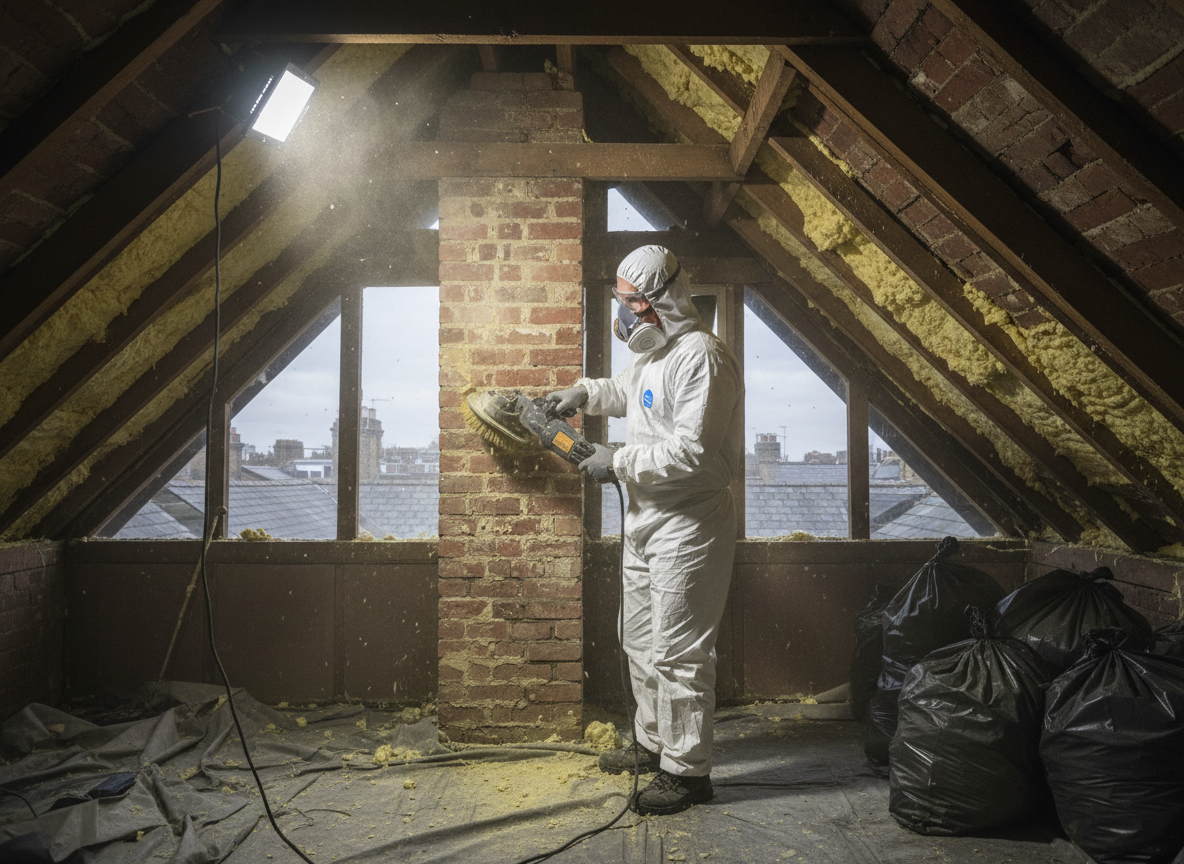
London's older housing stock, particularly Victorian and Edwardian terraces in areas like South Woodford and Waltham Forest, frequently received spray foam in lofts during the 2000s energy upgrades. Over time this closed-cell material traps moisture against original timbers and lath-and-plaster ceilings, leading to rot that only becomes visible once the foam is cut back. Removal crews must work around fragile lathe, chimney stacks, and party walls without disturbing neighbouring properties.
Greater London's damp climate and frequent rainfall mean any remaining foam residue quickly re-absorbs water, so extraction includes full vacuuming and drying checks before new insulation can be considered. Properties near the Lea Valley or on clay soils also face higher humidity levels that accelerate timber decay once the foam barrier is gone. Technicians therefore test moisture content at multiple depths before signing off.
Removal work in E18 and surrounding postcodes often reveals hidden electrical cables and pipework buried under thick foam layers applied during rushed installations. Cutting too close risks damaging 1970s-era wiring still common in many terraces. The process therefore starts with careful mapping and hand-tool sections around services rather than aggressive mechanical stripping.
Common Triggers for Removal
Homeowners in London typically call after noticing ceiling stains or musty smells in winter when heating drives moisture upward. Another frequent trigger is when properties change hands and surveyors flag the foam as non-compliant with current building regulations for ventilation.
Technician insight
In London the thing that catches most people out with spray foam insulation removal is how often the foam was sprayed straight over original Victorian lathe without any ventilation gap. Once you start peeling it back in an E18 terrace you find the timber already softening because the foam trapped every bit of winter rain that came through the tiles.
South Woodford Loft Extraction
A homeowner in an 1890s terrace near George Lane noticed dark stains on bedroom ceilings after heavy December rain. Inspection showed closed-cell foam had been applied directly to rafters, blocking airflow and allowing condensation to soak the original timbers. The team cut out the foam in controlled sections, treated the exposed wood, and restored ventilation paths. The ceiling remained intact and no further staining appeared the following winter.
How it works
- 1
Initial Assessment
Survey the loft or wall cavities to measure foam depth, check for hidden services, and test timber condition.
- 2
Containment Setup
Seal the work area with plastic sheeting and negative air machines to prevent dust migrating into living spaces.
- 3
Mechanical Removal
Cut and peel foam in sections using oscillating tools, keeping blades away from lathe and cabling.
- 4
Cleanup and Drying
Vacuum residue, treat any exposed timber, and run dehumidifiers until moisture readings stabilise.
- 5
Final Inspection
Walk-through with the client to confirm all foam is gone and ventilation paths are clear.
Pricing
Cost depends on foam thickness, access difficulty, and property size. Upfront quotes provided after site visit.