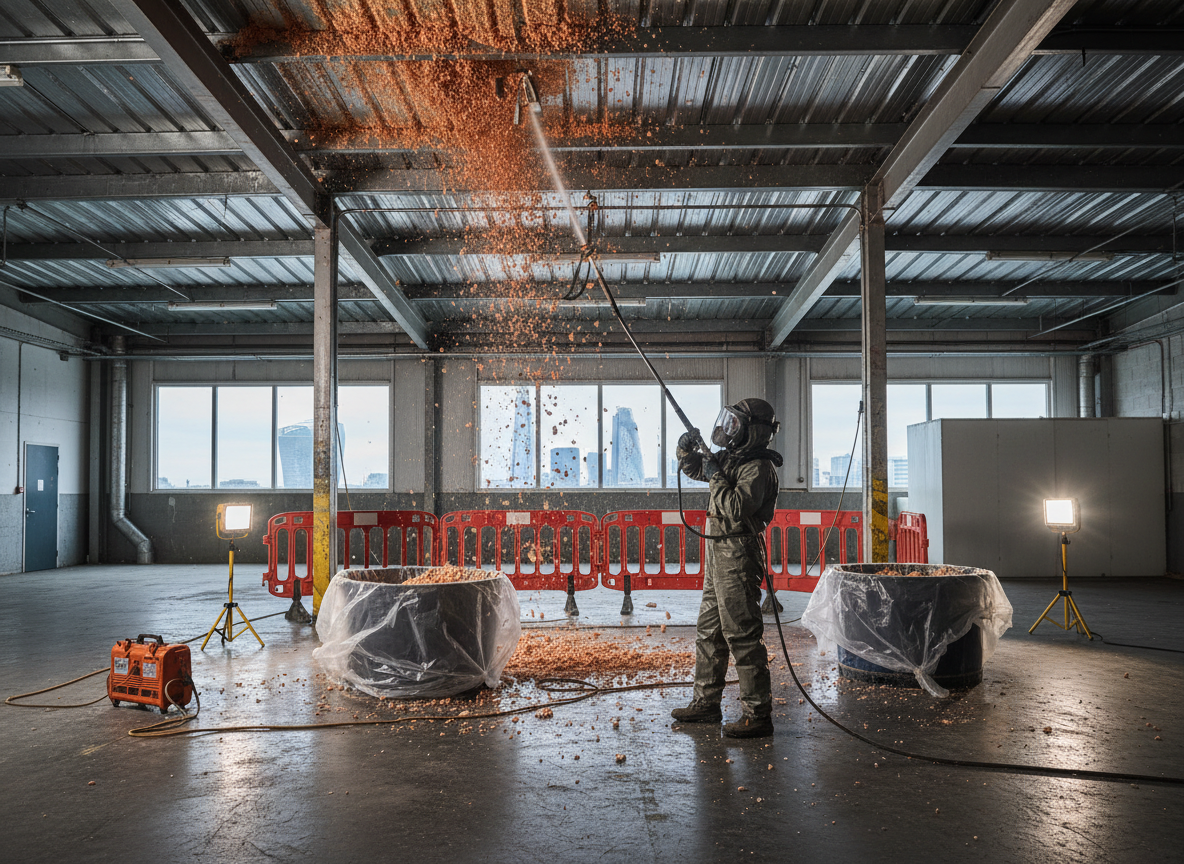
Warehouses in London often feature spray foam applied directly to brick, steel or concrete during the 1980s and 1990s refurbishments. Over time the material degrades, traps moisture against the fabric and creates hidden condensation problems in buildings that already sit on clay soils with high water tables. Removal requires careful separation of the foam from original substrates without damaging structural steel or listed elements common in East London industrial stock.
London weather adds further complications. Persistent rainfall and mild winters keep residual moisture high inside roof voids, so crews must allow extra drying time before any new insulation can be considered. Older warehouses near the Thames or Lea Valley frequently contain mixed insulation layers, including older mineral wool or asbestos-containing boards that must be identified and handled separately under current HSE guidance.
Edge cases include high-bay spaces where foam was sprayed over services and lighting runs. These require sectional access and temporary propping to avoid disrupting operations. Code notes for Greater London stress that any removal disturbing the building envelope must comply with current Part L and fire-spread requirements, especially where the unit adjoins residential conversions.
Pureguard Solution operates from 139 George Lane, London E18 1AL and maintains 24/7 availability for urgent warehouse callouts. Every job begins with a site survey that records substrate condition, access constraints and any adjacent tenancies before work starts.
Technician insight
In London, the thing that catches most people out with Warehouse spray Foam removal is the hidden second layer of older insulation sitting behind the spray foam in 1970s and 1980s industrial units, especially around the Lea Valley where damp clay and frequent rain keep the cavity wet for months after the foam is stripped.
Hackney warehouse roof void
The unit had spray foam applied over an existing mineral-wool layer that had become saturated. We found water trapped against the steel purlins and evidence of previous condensation staining. After sectional removal and drying, the client received a clean substrate ready for new insulation and a full waste transfer note for the removed material.
How it works
- 1
Site Survey and Risk Assessment
Technicians inspect the warehouse roof, walls and floor voids, identify mixed materials and note access routes and neighbouring properties.
- 2
Containment and Dust Control
Full polythene enclosures and negative-air units are installed to keep foam particles inside the work zone and protect stored goods.
- 3
Mechanical Removal
Foam is cut and scraped in controlled sections using low-vibration tools to limit vibration transfer to steel frames and brickwork.
- 4
Substrate Cleaning and Disposal
Remaining residue is removed, surfaces are cleaned, and all waste is bagged for licensed off-site disposal.
- 5
Final Inspection and Handover
The area is checked for remaining foam and moisture levels; a written report is provided for the building owner or managing agent.
Pricing
Upfront quotes issued after on-site inspection; final cost depends on building height, access restrictions and volume of foam.